A brief has to give the court something it can act on.
The book is built around a practical federal-court problem: identifying the candidate errors that can become filing-worthy arguments, proving them from the administrative record, meeting the Commissioner’s strongest lawful answer, showing why the error mattered, and asking for no more relief than the defect supports.
Not every error belongs in the brief.
The method is a screen. Its purpose is to eliminate weak candidates before substantial briefing time is spent.
The record has to carry the argument.
Section 405(g) review is not a second hearing. The argument must be provable from the decision and the administrative record without asking the court to reweigh evidence.
Harm cannot be an afterthought.
A defect without a supported harm chain is not a filing-ready issue. The book treats harm as part of argument construction itself.
The Six Moves
Ask them of every candidate ordinary merits error, in order, before drafting. The sequence is a drafting protocol—not a rule of law.
Requirement
What enforceable rule required the adjudicator to act, in the version that governed?
Failure
What did the decision actually say—or fail to say? Quote it rather than supplying a step the adjudicator never took.
Proof
What in the administrative record establishes the failure without turning the argument into reweighing?
Foreclosure
What is the Commissioner’s strongest lawful answer to the ground itself, and can you neutralize, limit, or concede around it?
Harm
If the court agrees, what changes? Build the chain of cited propositions ending in the legal consequence.
Remedy
What relief does the defect support—and no more? Do not ask the court to make findings reserved to the agency.
The federal-court numbers point toward articulation and rationale.
of FY2025 federal-court disability decisions were remands; 1% were coded as allows.
What the courts are citing. In every fiscal year shown since 2010, an inadequate-articulation or inadequate-rationale category has ranked first in SSA’s remand-reason data. The one-page aid gives the FY2025 top four and the source citations.
Context, not proof. The method tests whether a candidate error can become an argument a reviewing court can act on. Circuit-specific law still governs the answers.
Take the Six Moves with you.
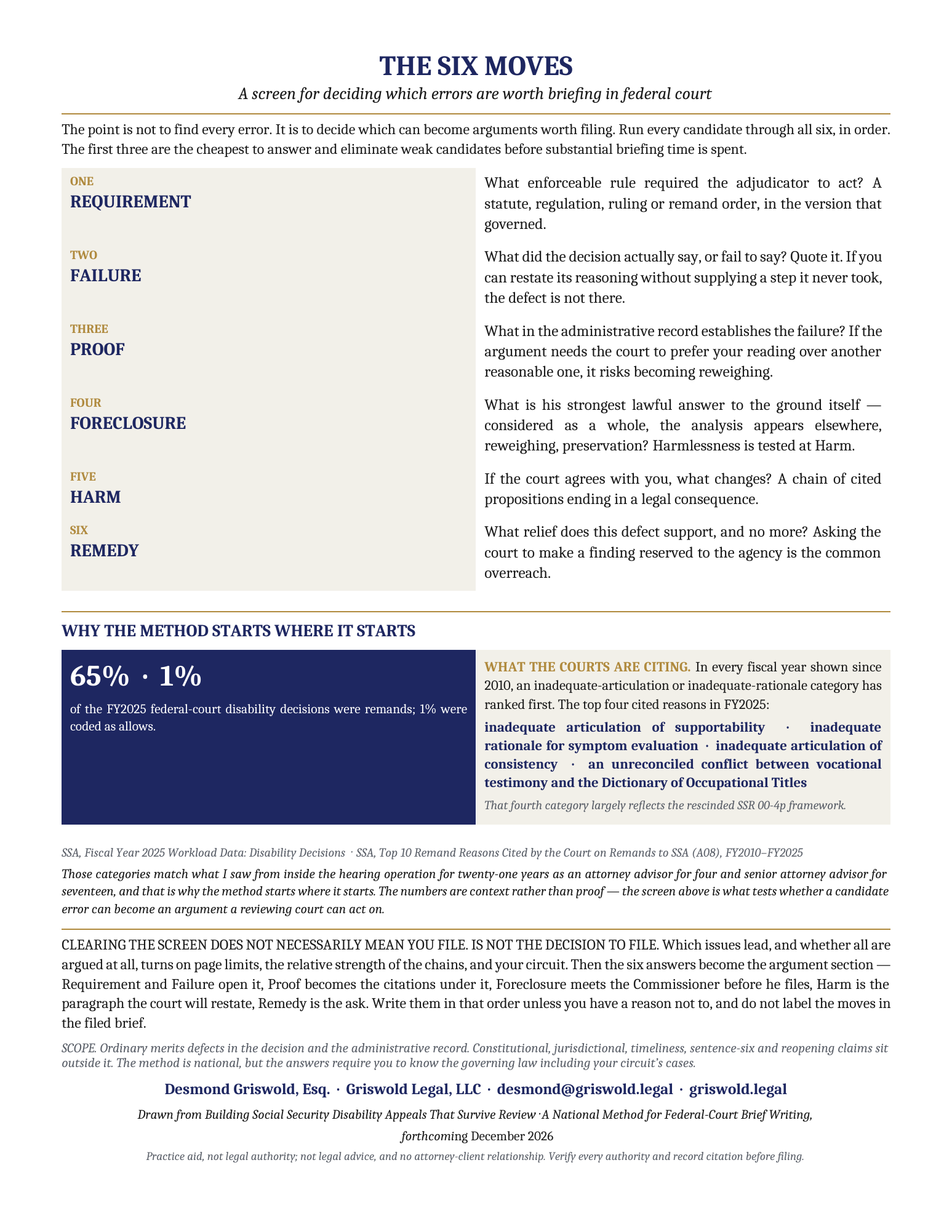
The one-page aid condenses the screen into a desk reference: the six questions, the FY2025 context, scope, and the warning that clearing the screen is not itself the decision to file.
Free PDF. No form required. Practice aid, not legal authority; verify every authority and record citation before filing.
Desmond Griswold
Desmond Griswold has worked on Social Security disability cases for more than three decades, on both sides of the adjudicative process. From 2004 through 2025 he served in the Social Security Administration’s hearing component as an Attorney Advisor and then Senior Attorney Advisor. He founded Griswold Legal, LLC in 2026.
The method grows out of years of writing decisions and reading agency decisions and federal remands—and focuses on the operational problem of turning an arguable defect into an argument a reviewing court can act on.